
Sermon
Through the Eyes of Grace
Sunday, September 20, 2026
The Rev. Lucia Lloyd
Share This Sermon
Scripture Reading
Select the Bible reference below to read the passage without leaving the sermon.
We sympathize with the labourers in today’s parable who worked hard all day long. We know what it feels like to work hard. We know what it feels like not to get the rewards we expected. We know what it feels like to see others get things they don’t deserve. We know what it feels like when we are treated unfairly. For many of us, these feelings go way back to childhood. There is the pain of them. And even beyond the pain, there is the sense of injustice. It sticks in our craw: it just feels wrong and unfair when pay isn’t based on the amount of work a person has done.
Jesus knows we feel that way. Jesus knows humanity better than we know ourselves. And because Jesus knows we feel that way, Jesus offers us this parable.
Many people, starting with the disciples themselves, and continuing to the present day, ask why Jesus so often speaks in parables. If he’s got something to say, why doesn’t he just say it plainly? In looking at today’s parable, we discover why. It is not just that we are looking at the parable; it is that the parable is looking at us. It is not just that we are asking questions about the parable; it is that the parable is asking questions of us.
Because Jesus understands us so thoroughly, Jesus wants us to see in ourselves what he sees in us. This is an uncomfortable process at first, because it is uncomfortable to question assumptions we didn’t know we were making, and especially because some of the things we see in ourselves do not boost our ego. However, Jesus asks us to go through this uncomfortable process because Jesus can see who we really are and who God really is, and Jesus wants to give us that deeper understanding of ourselves and that deeper understanding of God.
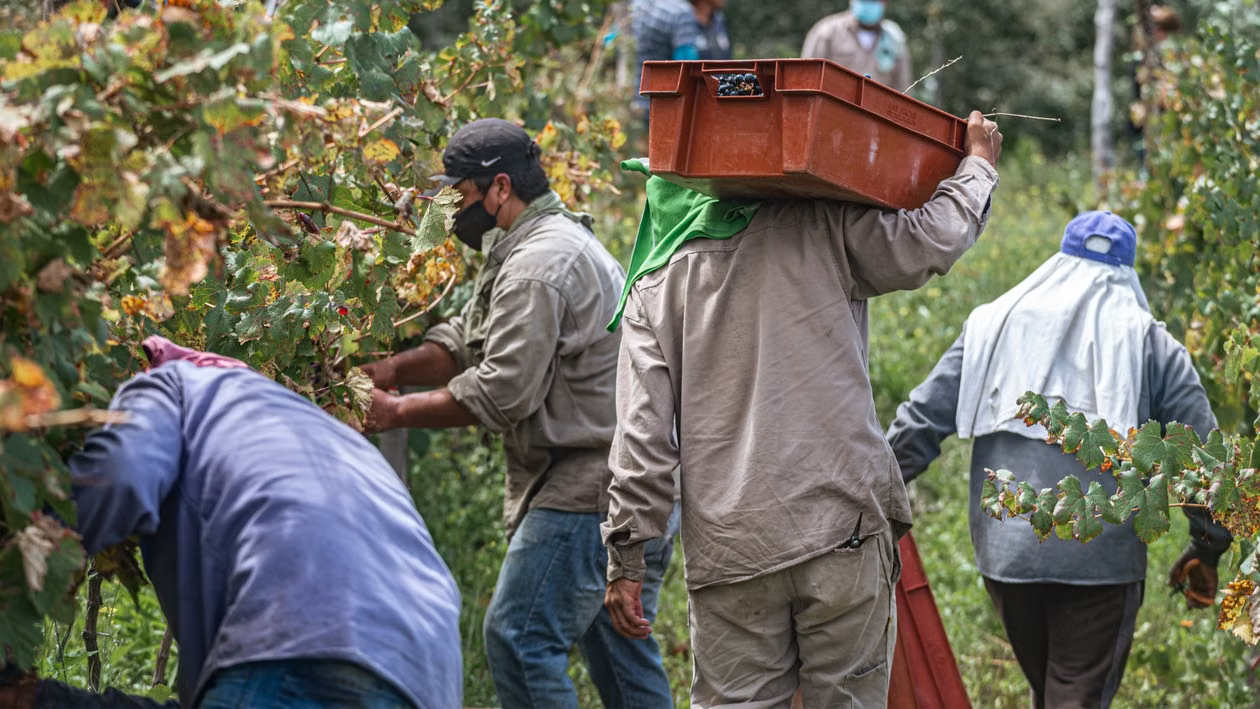
We can picture the landowner going out early in the morning to hire the day labourers to work in his vineyard, agreeing with them for the usual daily wage, and sending them into the vineyard. We can imagine him going back at 9:00 to get some more labourers who are looking for work. It seems odd that he’d go back again at noon and at 3:00 to hire people to work just part of the day, and it seems especially odd that he’d go back at 5:00 to hire people to work for just one hour. At the end of the day, when the labourers who worked all day see the people who worked for one hour get the usual daily wage, a denarius, it’s no wonder they would expect to be paid more than that. When they get their denarius, the usual daily wage, they grumble against the landowner. They say, “These last worked only one hour, and you have made them equal to us who have borne the burden of the day and the scorching heat.” The angry accusation: “you have made them equal to us.” And here is where Jesus shows us something about ourselves. We humans talk about the way we value equality. We think nice thoughts about equality. We say that we believe that God loves everybody equally. And Jesus knows the truth about us, that at an emotional level, we hate it when others are made equal to us. What we really want, deep down, is to be better than other people, and to have God recognize that we are better than those other people. It is the same motivation the disciples have when they ask Jesus, “Who is the greatest in the kingdom of heaven?” It’s not really that we’re longing for the kingdom of heaven itself, what we want is to be the greatest in the kingdom of heaven.
Jesus sees in us the uncomfortable truth that underneath our attempts to love our neighbours, there is also the desire to beat our neighbours in the competition and show that they’re inferior and we’re superior. We are so accustomed to this mentality that we don’t even notice we are in it. We are so used to the way the kingdoms of the world work that it’s hard for us to imagine that the kingdom of heaven is different. Jesus gives us this parable as a way of looking at the emotions and priorities of these labourers, which are our own emotions and priorities, and questioning how different they are from the kingdom of heaven. The kingdom of heaven is not a spiritual rat race. The kingdom of heaven is not where we are locked in an endless struggle to prove we are better than the people we look down on, and to make sure we get more credit for it and our neighbours get less.
Somebody may be thinking, “No, my heart is pure and I never feel that kind of anger that other people feel, and I’m completely innocent of any desire to be better than anybody else, because I’m not like those other people who have that desire. I just believe a person should do a fair day’s work for a fair day’s pay.” First, Jesus sees very clearly the irony of those who think they’re purer and more innocent than others while they’re at that moment claiming they don’t feel superior to anyone. Second, Jesus answers the “unfairness” accusation directly in this parable. The landowner replied to the labourer, “Friend, I am doing you no wrong; did you not agree with me for the usual daily wage?” He is absolutely right. Before the workday started, he agreed with the labourers for the usual daily wage. They did a fair day’s work and they got a fair day’s pay. It is all completely fair. The landowner has done nothing wrong.
The labourer has done a fair day’s work and gotten a fair day’s pay and he will be able to go home and provide food for his kids tonight. We might think he would be happy about this. But he is not. He sees that his neighbour received a denarius and his neighbour will be able to provide food for his kids tonight. We might think he would be happy about that too. But he is not. What would make him happy is for his neighbour’s kids to go hungry tonight.
In this parable, Jesus is saying, “Do you see how warped this desire for your neighbour’s kids to go hungry is? Do you see how warped this whole attitude is? Do you see that all the things that, at first, look like issues of fairness that you feel aggrieved about, are really based on assumptions you didn’t know you were making, which are completely opposed to the way the kingdom of heaven operates?
We are used to the way the world works, where we try to control the outcome of our lives by working harder, trying to outrun everyone else in the rat race, trying to win the endless competitions against everybody and anybody. Jesus is showing us that’s not the way the kingdom of heaven works. In the kingdom of heaven, we don’t control God by how hard we work. In the kingdom of heaven, we realize that everything we receive is a gift from God.
In the kingdom of heaven, God loves you bountifully. In the kingdom of heaven, God also loves your neighbour bountifully. You don’t have to grumble about the unfairness of God’s bountiful love for your neighbour. You can be happy for your neighbour.
In the kingdom of heaven, God has mercy on your weaknesses and sins. In the kingdom of heaven, God also has mercy on your neighbour’s weaknesses and sins. You don’t have to grumble about the unfairness of God’s mercy on your neighbour. You can be happy for your neighbour.
In the kingdom of heaven, God gives you gifts because God is generous. In the kingdom of heaven, God also gives your neighbour gifts because God is generous. You don’t have to grumble about the unfairness of God’s generosity to your neighbour. You can be happy for your neighbour.
Do you really want to say to God, “You should love me, but you shouldn’t love anybody else?” Do you want to say to God, “You should be merciful to me, but you shouldn’t be merciful to anybody else? Do you really want to say to God, “You should be generous to me, but you shouldn’t be generous to anybody else?”
The landowner says “I choose to give to this last the same as I give to you. Am I not allowed to do what I choose with what belongs to me? Or are you envious because I am generous?” These are questions that are not just for the labourer, they are questions that this parable asks us, questions that Jesus asks us.
In the last question, the translators add a bit of their own interpretation in order to help us out with understanding the point, so they say “Are you envious because I am generous?” Still, I love what this verse says in the original Greek, which is “Is your eye evil because I am good?” When we humans look at what happens in this parable from our usual perspective, we see things as unfair, we are angry, we grumble, we want our neighbours to have less than we do. Our eyes are evil. Jesus tells us this parable so that we can feel what’s wrong with that point of view. Jesus shows us in this parable that we can look at our relationships through new eyes. We can look at our relationships through the eyes of the landowner, who is both fair and generous. We can look at our relationships through the eyes of Jesus. We can look at our relationships through the eyes of God.
When we look at our relationships through Jesus’ eyes, we see our own need for repentance for the sinful attitudes we were too blind to recognize before. When we look at our relationships through Jesus’ eyes, we see that God grants us mercy far more than anything we or any other human being could earn, work for, or deserve. When we look at our relationships through Jesus’ eyes, we see that God grants us gifts far more than anything we or any other human being could earn, work for, or deserve. When we look at our relationships through Jesus’ eyes, we see that God grants us love far more than anything we or any other human being could earn, work for, or deserve.
When we look at our relationships through Jesus’ eyes, it may also change the way we view our neighbour, so that we no longer see our neighbour as someone to beat in a competition, or to envy, or to begrudge gifts to. Instead, when we look at our relationships through Jesus’ eyes, we may see our neighbour as someone we can show mercy to, someone whose well-being we can rejoice in, someone we can love.
Jesus offers us the opportunity not only to understand this parable, but to understand ourselves and to understand God. Jesus offers us this parable as an invitation to be transformed by God’s love so that our old evil eyes are no longer the only way we can see. In this transformation we can see through the eyes of God, which enables us to see the kingdom of heaven, in all the splendor of its mercy, all the sparkle of its generosity, and all the radiance of its love.