
Sermon
Love That Gives, Faith That Serves
Sunday, September 27, 2026
The Rev. Lucia Lloyd
Share This Sermon
Scripture Reading
Select the Bible reference below to read the passage without leaving the sermon.
Affection runs throughout today’s passage from Philippians, and affection runs throughout all of the Apostle Paul’s letter to the Church in Philippi. Friendship is part of it. As you read Philippians, you can feel that Paul is among friends here more than he is in his letters to the other churches. There is also more to it than friendship, because these are spiritual bonds, bonds in faith, bonds in shared service to Christ. Paul begins his letter by saying, “I thank my God every time I remember you, constantly praying with joy in every one of my prayers for all of you, because of your sharing in the gospel from the first day until now.” [] He goes on, “It is right for me to think this way about all of you, because you hold me in your heart, for all of you share in God’s grace with me, both in my imprisonment and in the defense and confirmation of the gospel.” [] Paul affirms the love and the shared service in his relationship with them, but he does not stop there. In this letter, he emphasizes repeatedly his exhortation for their relationships with one another.
Even though Paul is writing this letter while he is in prison, he writes frequently of his joy and his rejoicing, which come from his relationship with his fellow Christians and with Christ. He prays with joy for the Christians in Philippi, and in today’s passage he tells them what will make his joy complete: “If then, there is any encouragement in Christ, any consolation from love, any sharing in the Spirit, any compassion and sympathy, make my joy complete; be of the same mind, having the same love, being in full accord and of one mind.” Paul teaches that our relationship with Christ is not meant to be private and individual, it is meant to affect our relationship with others in the church.
Our natural inclinations tend to bend our thoughts toward the self: how can I get what I want? How can I get more approval and appreciation from this person? How is this group beneficial to me? Do these people recognize what a good person I am? Does this person see that I’m important? What’s in it for me?
Paul knows from his own bitter experience how much those thoughts can infiltrate our attitudes. He knows from his own transformative experience of God that Christianity involves focusing on the opposite of those self-centered goals. So he writes, “Do nothing from selfish ambition or conceit, but in humility regard others as better than yourselves. Let each of you look not to your own interests, but to the interests of others.” It is the nature of Christian love to care for another person’s well-being, not just your own. It is the nature of Christian love to do what is beneficial for the whole group, not just what’s beneficial to me. Shifting from a self-centered mindset to prioritizing another person, and the church community as a whole, is not an easy task, and it is a work in progress throughout our lives.
Next, Paul writes about why we make this shift. This next section of today’s passage reads like a poem or a hymn, and many scholars call it “the Christ hymn”. In it, Paul explores the nature of Christ, and how we hope to be more like Christ:
“Let the same mind be in you that was in Christ Jesus, who, though he was in the form of God, did not regard equality with God as something to be exploited, but emptied himself, taking the form of a slave, being born in human likeness, and being found in human form, he humbled himself and became obedient to the point of death even death on a cross.” []
It feels to me like a descent, from letting go of equality with God, taking on human form, and not a powerful form but a slave, continuing to humble himself, being obedient to the point of death, even the most humiliating and painful death on a cross.
It is after gradually giving up everything, even to the point of death on a cross, that resurrection comes, and humiliation turns to exaltation and glory:
“Therefore, God also highly exalted him and gave him the name that is above every name, so that at the name of Jesus every knee should bend, in heaven and on earth and under the earth, and every tongue should confess that Jesus Christ is Lord to the glory of God the Father.
This is the Christ we worship, a Christ of humility and sacrifice that ultimately results in praise and adoration. This is also the Christ we seek to imitate, as we strive to resist the temptations to win power or approval for ourselves, and as we strive instead for humility and care for others.
Next, Paul says, “Therefore, beloved, just as you have always obeyed me, not only in my presence, but much more now in my absence, work out your own salvation with fear and trembling; for it is God who is at work in you, enabling you both to will and to work for his good pleasure.” I love that paradox there, that Paul is telling us “get your work done on your salvation” combined with the big picture “for it is God at work in you.” When we are doing our part doing the work of our faith, it seems at first that we are doing it ourselves, but it turns out that God is at work in us the whole time. If we are just sitting around as couch potatoes, God isn’t going to do all our work for us. But as we get to work in our faith, God uses our efforts to work through us. And since our own motivation sometimes fades, I especially like this next part: “for God is at work in you, enabling you both to will and to work for his good pleasure.” I love that it is God who keeps giving us the WILL to work as well as enabling us to work. And as we do the work, we are working for God’s good pleasure. God gives us the will, God enables our work, and God takes pleasure in the work we do.
So with all this wonderful motivation to imitate Christ, and all this divine action in us, what are the practical ways we can do what this scripture teaches us, “Let each of you look not to your own interests, but to the interests of others.” One important way we do that is in what we choose to do with our money. People can talk about what they think their values are, but where you put your money and where you put your time show what you truly value in reality. The encouraging part of that is that if you (like the rest of us) have slipped into some bad habits, and the deepest part of your soul wants things that are more meaningful than those bad habits, you can choose to change what you do with your money and your time, so that your life aligns with your soul’s deepest values.
In Philippians, Paul talks directly about the importance of giving money for ministry and for the good of the church. In chapter 4 he thanks the in Philippi for giving him money to keep him alive and to fund his ministry. He expresses to them how much he values both the gift itself and the way it shows that they care about his distress and are willing to do something about it. He goes even further and says that they alone shared with him and gave to him in the early days of the gospel, and even when he was in Thessalonica they sent him help for his needs more than once. His deep affection for the Philippians and the bonds in the service of Christ that they share have grown from the fact that the Philippians don’t just talk about how much they love him, they put that love into action by giving money to his ministry for the sake of the gospel. Paul knows that in order to give him this money, the members of the church in Philippi have sacrificed ways they would have spent that money on themselves. Paul sees this both as a gift to him for his ministry and as a gift to God. He writes, “I have received from Epaphroditus the gifts you sent, a fragrant offering, a sacrifice acceptable and pleasing to God.” []
The language of a fragrant offering and a sacrifice recalls the offerings and sacrifices of worship in the temple, and, even more importantly, the offering and sacrifice of Christ himself on the cross. Paul also has made many painful sacrifices for the sake of the gospel, and he writes, “I regard everything as loss because of the surpassing value of knowing Christ Jesus my Lord. For his sake I have suffered the loss of all things, and I regard them as rubbish in order that I may gain Christ and be found in him.”
One form of giving is to see if there’s anything left over after we’ve covered our own expenses, and to give some of that to the church. In contrast, sacrificial giving is to choose in advance to look not to your own interests, but to the interests of others, which is to choose to make some sacrifices in putting your money toward not your own interests, but to the interests of the whole congregation. Congregations where each individual focuses not on “what’s beneficial for me?” but on “what’s beneficial for the whole group?” and where individuals devote their money to what is beneficial to the whole group--these are the congregations who thrive, even in tough times.
Yes, this does involve sacrificing some money you would have spent on yourself, for the sake of the greater good, and it is a way to move beyond self-centeredness. How much money are we talking about? Different people are in different financial circumstances, so instead of talking about the same amount for everyone, we talk about proportional giving, in which you give a percentage of the money that goes into your bank account each month. The Biblical standard of giving is a tithe, which is to give to the church 10% of the money that comes into your bank account each month. I started doing that when I was a layperson, and have continued, and I recommend it. If 10% is more than you’re ready for right now, you can start at 1% of the money that comes into your bank account each month and give that to the church. As we start this year’s stewardship program, we are asking people to make a choice now to give through PAR, which stands for pre-authorized remittance. Signing a PAR form means your donation is made automatically each month and our church can count on you for that money to arrive reliably and dependably each month. We appreciate each and every gift, of every size and by every method. Still, we see the way other forms of giving go up and down at different times of the year. Day in and day out, our PAR givers are the trustworthy foundation of our church. If you are already a PAR giver, we invite you to consider increasing your gift to grow the foundation of our church and its ministries. If you are not yet a PAR giver, we invite you to put your faith into action by signing a PAR form.
The word “sacrifice” also means “to make sacred”. When we sacrifice some of our own spending for the sake of the gospel and its ministry, we are making our money sacred by devoting it to sacred purposes. The way we spend our money and the way we spend our time show what our values truly are. When we sacrifice some of our time for the sake of the gospel and its ministry, we are making our time sacred by devoting it to sacred purposes. Since how we spend our time is how we spend our life, it is a way of making our life sacred.
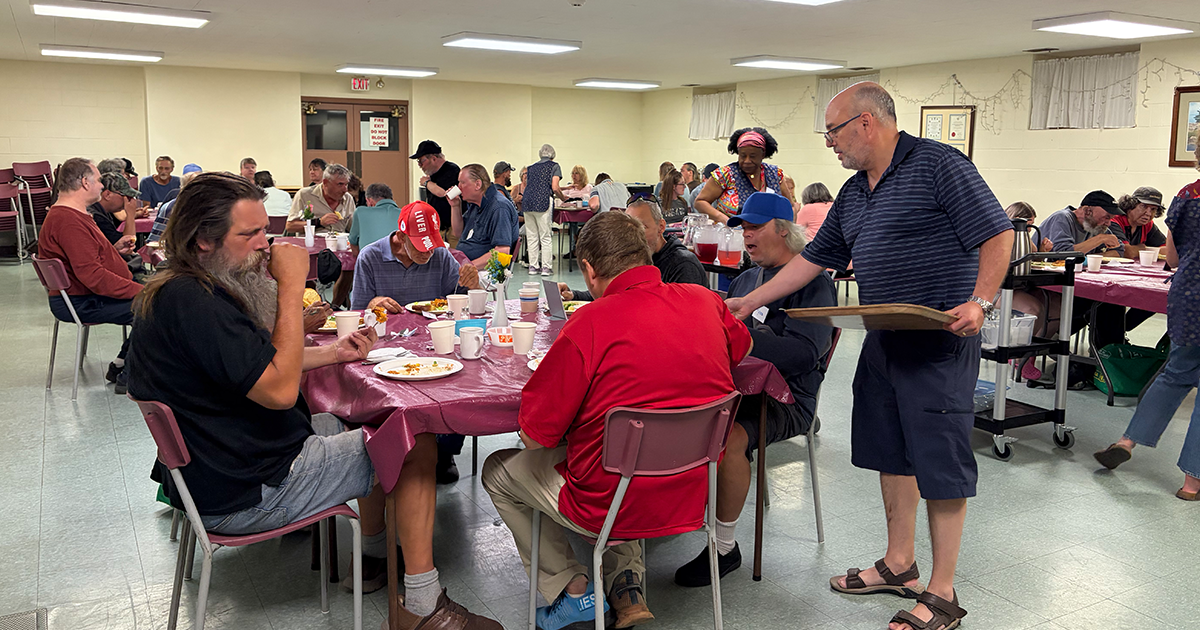
There are a wide variety of ways here at St. John’s that you can look to the interests of others, not just to your own interests, in where you put your time. If you want to love your neighbours who attend our Saturday Soul Suppers, you can carry out Christ’s teaching by cooking, or serving, or washing dishes. If you want to love your neighbours who are children, you can help with the church’s children’s program. If you want to lift up songs of joy and praise to God, you can help by singing in the choir. If you want to add beauty to our worship you can help with the . The list goes on. And it’s not a metaphorical list either; it’s a list that is included in your stewardship packets, where you can mark down what new ministries you would like to try. Caring about what’s in the best interests of another person, or what’s in the best interests of the entire group, rather than always looking at “what’s in it for me?” is the way we use our money and our time to put our faith into action, to put our love into action.
Paul knows from his own experience that sacrificing his money and his time for the sake of the church and for the sake of Christ is what brings him overflowing joy, even under the most difficult circumstances. Paul knows from experience that the Philippians who sacrifice their money and their time for the sake of the church and the sake of Christ are likewise growing in joy and love as they share in the gospel with him, and that brings him even more rejoicing.
Affection and shared service run through today’s passage and Paul’s letter to the Philippians. As we imitate Christ, affection and shared service in the gospel can increase in our lives too. We too have the opportunity to turn away from selfishness. My prayer for all of us is that we turn toward opportunities to use our money and our time to love, to give, to serve, to carry out the ministry of Christ, to praise, to give thanks, to rejoice.