
Sermon
A Woman, Some Yeast, and the Kingdom of Heaven
Sunday, July 26, 2026
The Rev. Lucia Lloyd
Share This Sermon
Scripture Readings
Select any Bible reference below to read the passage without leaving the sermon.
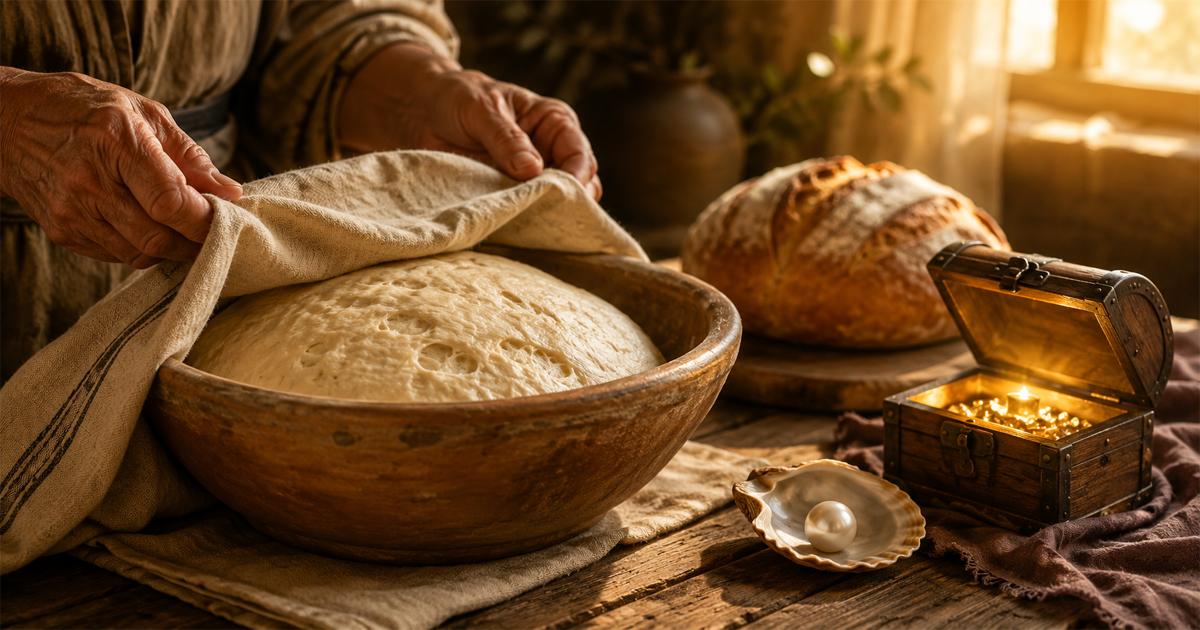
Like all of you, I am used to the convenience of 21st century supermarket bread sold in plastic bags, available whenever I want it, for my daily life. I do occasionally bake bread from scratch, using either a store-bought packet of dry yeast or a bit of sourdough starter, which is closer to the yeast used in Jesus’ time, as the scholar Amy-Jill Levine points out [Short Stories by Jesus, chapter 3]. When I do, I combine the ingredients, leave the small ball of dough in the bottom of a bowl, covered by a slightly damp dishcloth, and then go away to do other tasks. When I come back, there is something wondrous, almost magical, about the way that underneath the dishcloth, the tiny bit of yeast has quietly transformed the dough and grown it into something that has doubled in size. So I am grateful for the parable Jesus gives us in today’s gospel passage in which he tells us that the kingdom of heaven is like yeast.
When Jesus teaches people about the kingdom of heaven, he doesn’t do a lot of systematic explanation or analysis. He shows them ways to picture the kingdom of heaven in their mind’s eye. He engages their imagination by telling them stories, inviting them to become involved in what it feels like, where the surprises are, where the revelations are. He tells them parables. I get the sense that God is too big to fit into the categories and linear thinking we’re used to, and that pictures and stories are better at giving us a sense of who God is. More important than that is the sense of relationship. If you wanted me to have a sense of what your mother is like, you might tell me stories of various things that she’d done, or various ways she related to you at various stages of your life. You would not list facts about her such as her blood type or her driver’s licence number. Those facts wouldn’t mean much to me. But I can picture your stories in my mind, and feel connected to her through them. If you tell me something surprising my eyebrows will go up. If you tell a funny anecdote, I will laugh. I can relate to her through your stories. Jesus invites us to relate to God through parables. You might also show me some photos of your mother, and some of Jesus’ short parables are like snapshots of God from different angels.
Today’s gospel passage has two sections. The first section contains the parable of the mustard seed and the parable of the yeast. Both of them show something small and hidden that causes growth. The second section contains the parable of the treasure in the field, the parable of the pearl of great value, and the parable of the net. They show something hidden then found, which is of high value, so much that it’s worth letting go of everything else.
In the parable of the yeast, where our translation says “yeast that a woman took and mixed in with three measures of flour” the original Greek says “yeast that a woman took and hid in three measures of flour”. So it conveys this sense of hiddenness. And it’s true that the amount of sourdough starter yeast she would be putting into the flour is small, so much so that at the beginning you can’t tell the difference between a lump of dough that has yeast and a lump of dough that doesn’t. It’s only after time has passed that you can see the growth. And it’s not just that the little bit of yeast doubles in size, it’s that the little bit of yeast makes the entire dough double in size. This is what the kingdom of heaven is like.
The kingdom of heaven is like something as ordinary as a daily housework chore of making the day’s bread. The kingdom of heaven is like something as ordinary as the food we eat on a daily basis. And at the same time there is something magnificent about the smell of freshly baked bread, something magnificent about its warmth, and about the cracking sound as you break the crust, the softness of the inside, and the flavour of good bread that is truly comfort food. That is what the kingdom of heaven smells like, sounds like, feels like, tastes like.
In the parable of the treasure and the parable of the pearl, the focus is on how precious the kingdom of heaven is. But we have a sense that in its own way, yeast and the bread it creates are also precious. It is part of the preciousness of family meals, and hospitality to guests. It is part of feasting, celebrations, wedding banquets. It is part of the identity of Jesus, who tells us in the gospel of John, “I am the bread of life”. When Jesus breaks bread with his disciples, he says, “this is my body, given for you.” It is part of our worship each Sunday in the sacrament of .
The parable of the treasure and the parable of the pearl also show giving up everything for the kingdom of heaven. We see this kind of giving up everything in the lives of the disciples and other followers of Jesus during his lifetime. We see plenty of examples of it today too. When you talk to nuns and monks, you find that many of them gave up successful careers in which they were making a lot of money because they felt called to religious life instead. The same is true for many . People in our have told me about how coming to St. John’s and choosing to live a life of faith has transformed them. They develop new relationships with people in the congregation who also care about faith, and sometimes the guys they used to hang out with don’t really appeal to them much anymore. They want to spend their time differently. They want to spend their money differently. They want to quit addictive behaviours or unhealthy patterns. Some of the sacrifices they make are painful, for example, if family members disapprove of their new priorities, but they persist in those priorities anyway. Other sacrifices they hardly notice, until they look back later and see that what used to matter to them doesn’t anymore, and what didn’t matter in the past is now at the center of their lives. Sometimes these changes are sudden and dramatic; other times they are slow and gradual.
Looking at the parable of the yeast, the Biblical scholar Zina Jacque points out, “In a teaching sequence full of men, sowers, merchants, and fishermen, Jesus places a woman at the center of one of his most potent images of divine activity. She does not observe the kingdom. She enacts it. Her hands are in the dough. This is domestic labor as theological metaphor, and it has been underread for centuries.” [https://www.workingpreacher.org/commentaries/revised-common-lectionary/ordinary-17/commentary-on-matthew-1331-33-44-52-7] It is a valuable point. The woman whose hands are in the dough enacts the kingdom of heaven. And I would add that in an era before chemical preservatives, the bread for her household had to be made every day, so this woman had her hands in the dough every day. While this parable does not show a sudden, dramatic selling everything you have, it shows the daily sacrifice of getting up early every single morning whether you feel like it or not, caring for the living yeast at the right temperature day in and day out, putting your muscles into kneading the dough every single day. Consistently. Reliably. Faithfully. Jesus shows us that this too is what the kingdom of heaven is like.
The spiritual writer and Ron Rolheiser provides an example. He writes, “Imagine this: You are the dutiful daughter or son, and your mother is widowed and in an assisted living facility. You happen to be living close by, while your sister is living across the country, thousands of miles away. So the weight falls on you to be the one to take care of your mother. You dutifully visit her each day. Every afternoon on your way home from work, you stop and spend an hour with her while she has her early dinner. And you do this faithfully, five times a week, year after year.
“As you spend this hour each day with your mother, year after year, how many times each year will you have a truly stimulating and deep conversation? Once? Twice? Never? What are you talking about each day? Trivial things: the weather, your favorite sports team, what your kids are doing, the latest show on television, her aches and pains, and the mundane details of your own life. Occasionally you might even doze off for a while as she eats her dinner. In a good year, perhaps once or twice the two of you will share more deeply about something of importance; but save for that rare occasion, you will simply be filling the time each day with superficial conversation.
“But—and this is the question—are those daily visits with your mother superficial, mere duty, because your conversations aren’t deep? Are you simply going through the motions of an intimate relationship because of duty? Is anything deep happening?
“Compare this with your sister who is conveniently living across the country and comes home once a year to visit your mother. When she visits, both she and your mother are wonderfully animated; they embrace enthusiastically, shed tears upon seeing each other, and seemingly talk about things beyond the weather, their favorite sports teams, and their own tiredness. It seems that in this once-a-year meeting they have something that you, who visit daily, do not have. But is this true? Is what’s happening between your sister and your mother in fact deeper than what is occurring each day when you visit your mother?
“Absolutely not. What they have is, no doubt, more emotional, but it is, at the end of the day, not particularly deep. When your mother dies, you will know your mother better than anyone else knows her, and you will be much closer to her than your sister was. Why? Because all those days when you visited her and seemed to talk about nothing beyond the weather, deeper things were happening under the surface. When your sister visited your mother, things were happening on the surface (though emotionally the surface can look wonderfully more intriguing than what lies beneath it—that is why honeymoons look better than marriage).
“What your sister had with your mother is what novices experience in prayer and what couples experience on a honeymoon. What you had with your mother is what people experience in prayer and relationships when they are faithful over a long period of time. At a certain level of intimacy in all our relationships, including our relationship with God in prayer, the emotions (wonderful as they are) will become less and less important and simple presence—just being together—will become paramount. Previously, the relationship was developing on the surface, and emotions were important; now, emotions recede in importance…and deep bonding is happening beneath the surface.” [Insane for the Light: A Spirituality for Our Wisdom Years, chapter 5]
Rolheiser is illustrating an important truth here, which is often overlooked. The kingdom of heaven is often developing in the regular, daily, faithful practices of our relationship with God, whether they are emotional or not. As you devote yourself to your daily prayers and scripture readings, to weekly worship, service, and generosity to the church, to confessing your sins and trying again to love God and your neighbour, remember that Jesus teaches you that the kingdom of heaven is like yeast that a woman took and mixed in with three measures of flour until all of it was leavened.